
COST Action CA23125 TETRA – Transformation Electromagnetics for Tissue cHARActerization has reached an important milestone, completing its first two years of international collaboration and establishing strong foundations for the emerging field of Metamaterial Medicine.
TETRA brings together researchers across more than 40 participating countries and five interdisciplinary Working Groups, connecting expertise in biophotonics, electromagnetics, mathematical modelling, biological characterization, artificial intelligence and cancer research.
From Physics to Cancer Recognition
TETRA is investigating whether biological tissues can be quantitatively described through their measurable physical, structural and electromagnetic properties and whether these characteristics can provide new information for cancer recognition.
During its first two years, the network has advanced complementary research directions ranging from biomedical imaging and Raman spectroscopy to mathematical homogenization of highly disordered biological structures, digital pathology and AI-assisted cancer classification.
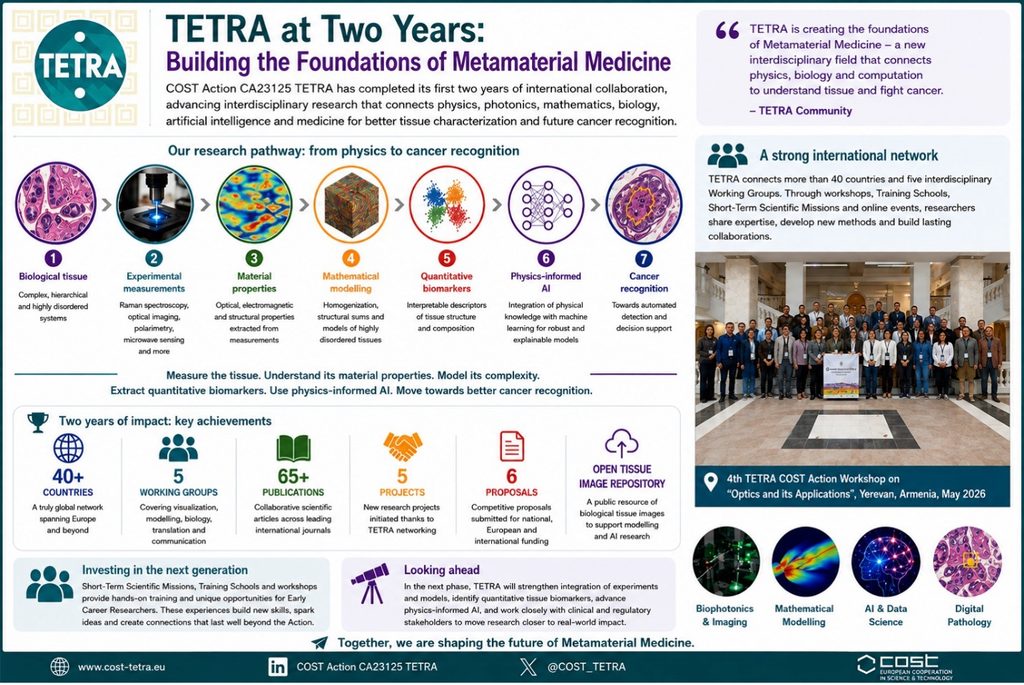
The emerging TETRA research pathway can be summarized as:
Biological tissue → Experimental measurements → Material properties → Mathematical modelling → Quantitative biomarkers → Physics-informed AI → Cancer recognition
Key Achievements
Among the achievements of the first two years are:
- 65+ collaborative scientific publications, demonstrating strong research productivity across the network.
- Development of standardized approaches for biological-tissue imaging, including Raman data preprocessing and image construction.
- Creation of a publicly accessible TETRA biological tissue image repository, providing resources for future modelling and cancer-detection research.
- Development of mathematical approaches for homogenization and characterization of highly disordered biological structures, including structural-sum-based methods.
- Progress towards automated cancer recognition and digital pathology, strengthened through collaboration with the Institut Germans Trias i Pujol (IGTP).
- Five projects and six proposals resulting from TETRA networking, demonstrating the network’s capacity to stimulate new collaborative research initiatives.
- A growing programme of Short-Term Scientific Missions, providing researchers with hands-on interdisciplinary training and generating new experimental systems, datasets and analytical methodologies.
Investing in the Next Generation
Early Career Researchers are central to the TETRA community. Short-Term Scientific Missions, Training Schools, workshops and international collaborations provide opportunities to acquire expertise that crosses traditional disciplinary boundaries—from advanced photonics and Raman spectroscopy to mathematical modelling, biomedical imaging and AI-assisted diagnostics.
These exchanges are also creating lasting connections between researchers and institutions across Europe and beyond, strengthening the human and scientific capacity needed for the future development of Metamaterial Medicine.
Looking Ahead
During the next phase, TETRA will focus increasingly on integration and validation: connecting experimental measurements with mathematical models, identifying quantitative tissue biomarkers, advancing physics-informed artificial intelligence, and strengthening clinical and stakeholder engagement.
The network will also continue developing cancer-classification methodologies and address regulatory and ethical considerations relevant to future translation.
Through sustained international collaboration, TETRA aims to establish Metamaterial Medicine as a new interdisciplinary research direction connecting physics, photonics, mathematics, biology, artificial intelligence and medicine.
Measure the tissue. Understand its material properties. Model its complexity. Extract quantitative biomarkers. Use physics-informed AI. Move towards better cancer recognition.