

From Imaging Biological Tissues to Understanding Their Material Properties
Metamaterial Medicine is an emerging interdisciplinary concept that applies principles from metamaterials, electromagnetics, photonics, mathematical modelling, and artificial intelligence to the quantitative characterization of biological tissues.
Within COST Action TETRA — The mETamaterial foRmalism approach to recognize cAncer (CA23125), biological tissue is considered not only as an anatomical structure to be visualized, but also as a complex, heterogeneous and highly disordered material whose measurable physical properties can contain information about its biological and pathological state.
This perspective creates a new bridge between physics, engineering, biology and medicine and provides the scientific foundation for developing quantitative approaches to tissue characterization and cancer recognition.
A New Way of Looking at Biological Tissue
Conventional biomedical imaging primarily asks:
What does the tissue look like?
Metamaterial Medicine introduces an additional question:
What are the physical and electromagnetic properties of the tissue, and how do they change with disease?
Biological tissues possess complex hierarchical structures extending from molecules and cells to extracellular matrices and macroscopic tissue organization. These structures influence the interaction of tissue with electromagnetic waves and light.
Consequently, measurable parameters such as effective permittivity, conductivity, refractive index, anisotropy, scattering, absorption and polarization response can potentially provide quantitative information about tissue organization and composition.
Disease alters biological structure. Cancer, for example, can modify cellular density, morphology, extracellular organization, vascularization, water distribution and other microscopic characteristics. Such structural changes can subsequently modify measurable optical and electromagnetic properties.
Metamaterial Medicine seeks to identify and interpret these relationships.
The Metamaterial Medicine Concept
The central concept can be summarized as:
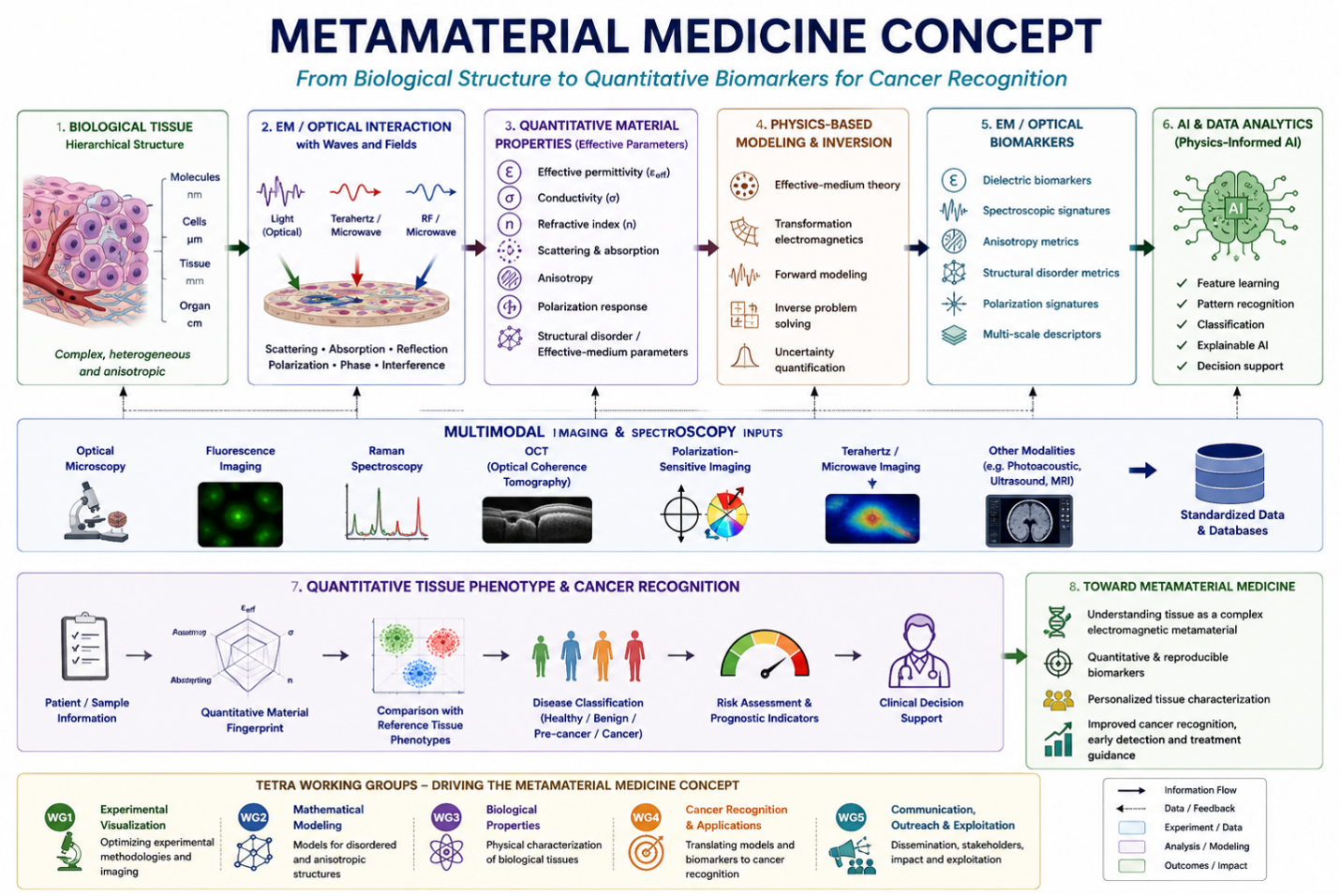
Rather than relying exclusively on image appearance, this approach aims to characterize tissue through quantitative physical descriptors.
Biological Tissue as a Complex Metamaterial
Engineered metamaterials obtain unusual electromagnetic properties from their internal organization rather than simply from the properties of their constituent materials.
Biological tissues share an important conceptual characteristic: their macroscopic physical response emerges from highly complex microscopic organization.
Cells, nuclei, membranes, extracellular structures, blood vessels, collagen networks and interstitial fluids form a heterogeneous multiscale architecture.
TETRA investigates whether concepts developed for the description of complex and disordered metamaterials can therefore provide new tools for understanding biological tissues.
The objective is not to claim that biological tissue is an artificially engineered metamaterial. Instead, metamaterial formalism provides a mathematical and physical language for describing the effective properties of complex biological structures.
From Medical Images to Material Biomarkers
A conventional biomedical image contains information about tissue morphology and contrast.
The Metamaterial Medicine approach aims to go further by extracting quantitative parameters associated with the physical organization of tissue.
Potential descriptors include:
-effective permittivity (εeff)
-electrical conductivity (σ)
-refractive index
-optical absorption
-scattering coefficients
-anisotropy
-polarization signatures
-structural disorder
-effective-medium parameters
-spectroscopic signatures
These parameters can be investigated as potential physical biomarkers.
The long-term objective is to determine whether combinations of these properties can distinguish healthy, precancerous and cancerous tissues in a quantitative and reproducible manner.
Multimodal Tissue Characterization
No single measurement technique captures every relevant property of biological tissue.
Metamaterial Medicine therefore encourages the integration of complementary imaging and spectroscopy modalities, including:
Optical microscopy
reveals cellular and tissue morphology.
Fluorescence imaging
provides molecular and functional information.
Raman spectroscopy
provides biochemical fingerprints of tissue.
Optical coherence tomography (OCT)
reveals depth-resolved microstructure.
Polarization-sensitive imaging
characterizes tissue anisotropy and structural organization.
Terahertz and microwave techniques
probe dielectric and electromagnetic tissue properties.
Other spectroscopic and biomedical imaging methods
provide complementary structural, chemical and functional information.
Instead of treating these modalities as completely independent diagnostic technologies, TETRA seeks to understand how their measurements relate to the underlying physical properties of biological tissue.
Mathematical Modelling and Effective-Medium Theory
Biological tissue is highly heterogeneous and disordered. Directly modelling every cell and microscopic structure is generally impossible at clinically relevant scales.
Mathematical homogenization provides an alternative.
Complex tissue microstructures can be represented through effective material parameters that describe their collective electromagnetic behaviour.
Within TETRA, mathematical approaches are being explored to connect: Microscopic tissue structure, Structural disorder and anisotropy, Effective material properties, Measurable electromagnetic response.
This relationship is fundamental to Metamaterial Medicine because it provides a physical bridge between biological architecture and diagnostic measurements.
Transformation Electromagnetics
Transformation electromagnetics provides another powerful conceptual framework.
Originally developed to control electromagnetic fields in engineered materials, transformation methods describe how changes in geometry and material parameters influence wave propagation.
Applied to biomedical problems, these concepts may help researchers understand how complex tissue morphology affects electromagnetic and optical fields.
This creates opportunities for improved modelling of:
wave propagation through heterogeneous tissues;
anisotropic biological structures;
electromagnetic scattering;
tissue deformation;
inverse problems;
quantitative reconstruction of tissue properties.
Artificial Intelligence Meets Physics
Artificial intelligence is increasingly capable of recognizing complex patterns in biomedical images. However, purely data-driven models may learn correlations without revealing the physical mechanisms responsible for them.
Metamaterial Medicine promotes a complementary approach:
Physics-informed artificial intelligence
Instead of providing AI systems only with raw images, models can also incorporate physically meaningful tissue descriptors.
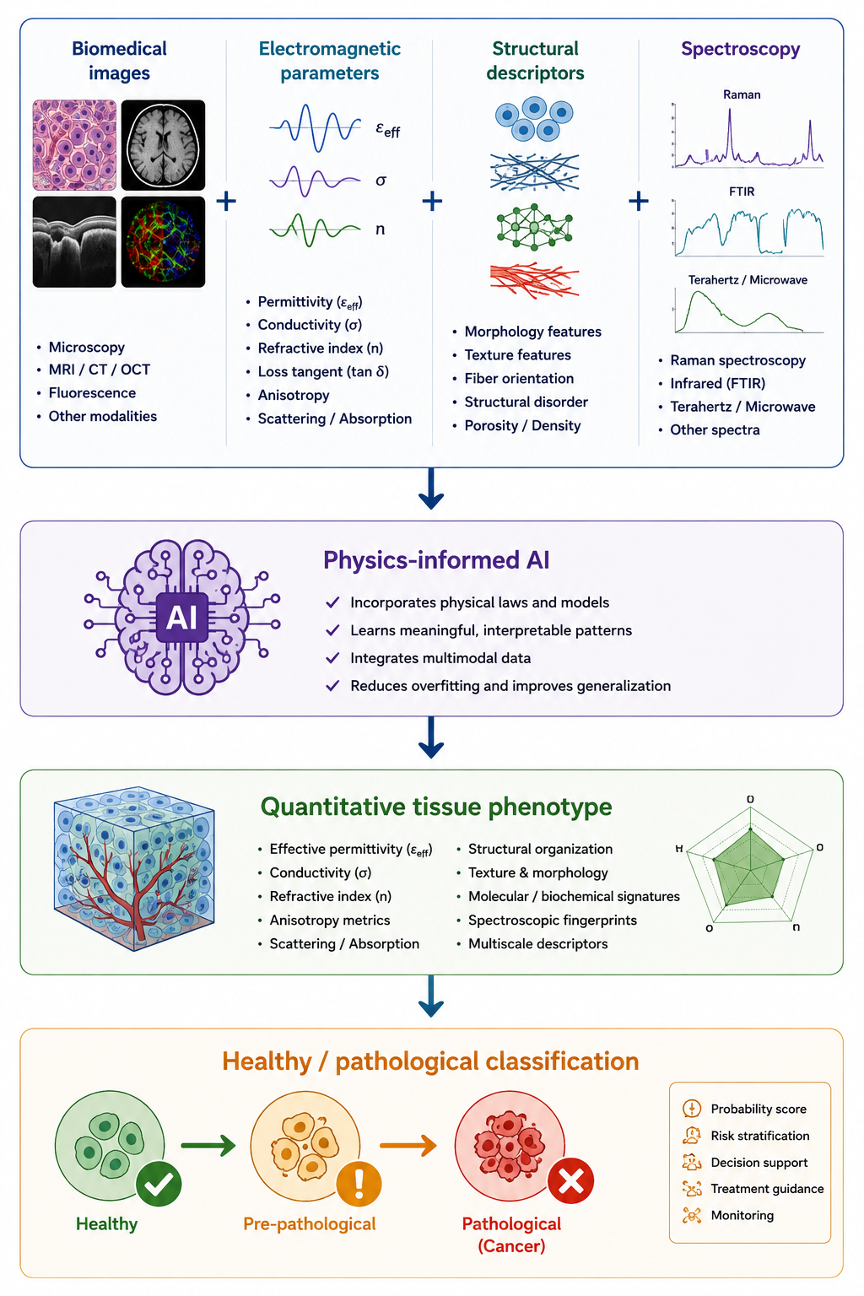
This approach could potentially improve interpretability, robustness and generalization while reducing dependence on purely image-based correlations.
Toward Cancer Recognition
Cancer produces structural and biochemical alterations across multiple spatial scales.
These changes may influence:
cellular morphology → tissue organization → electromagnetic properties → measured signals
TETRA investigates whether these relationships can be transformed into quantitative methods for recognizing pathological tissue.
The proposed paradigm is:
Traditional approachImage → Visual features → Expert interpretation
Metamaterial Medicine approach
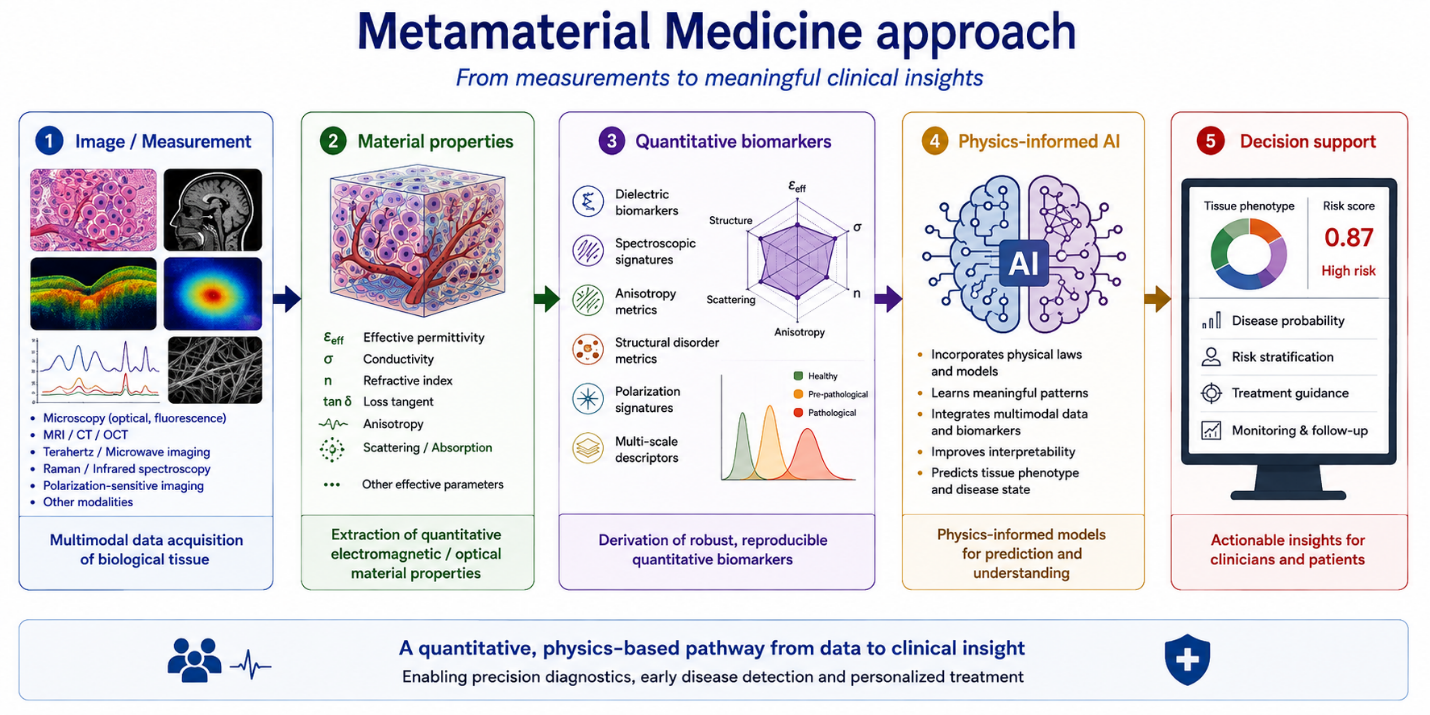
The two approaches should not be viewed as competitors. Instead, quantitative material characterization could provide additional information to complement established pathology, imaging and clinical assessment.
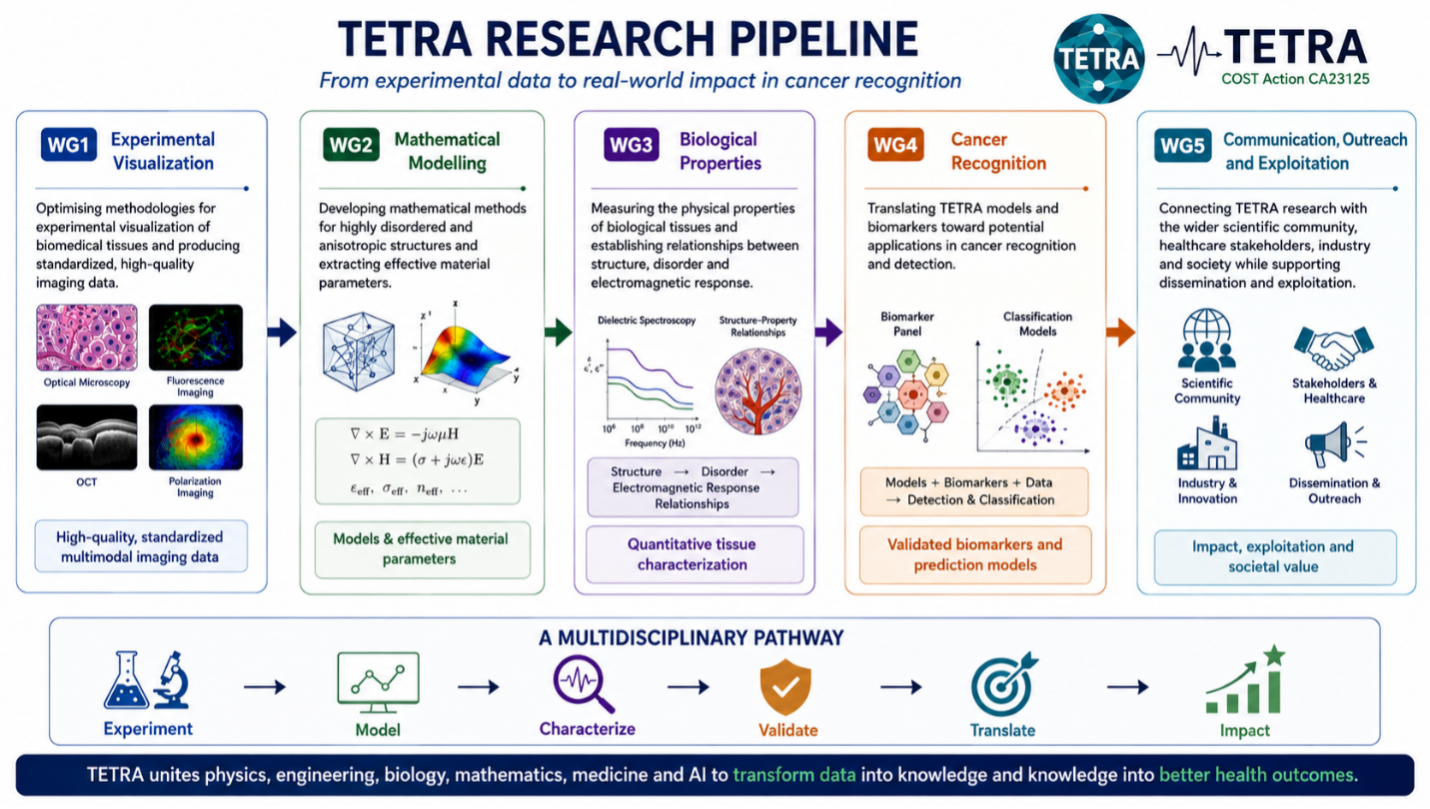
The TETRA Research Pipeline
The five TETRA Working Groups collectively support the development of this concept.
From Precision Imaging to Material Medicine
The long-term vision extends beyond producing better images.
Future biomedical technologies could generate a quantitative material profile of individual tissue, integrating multiple physical characteristics.
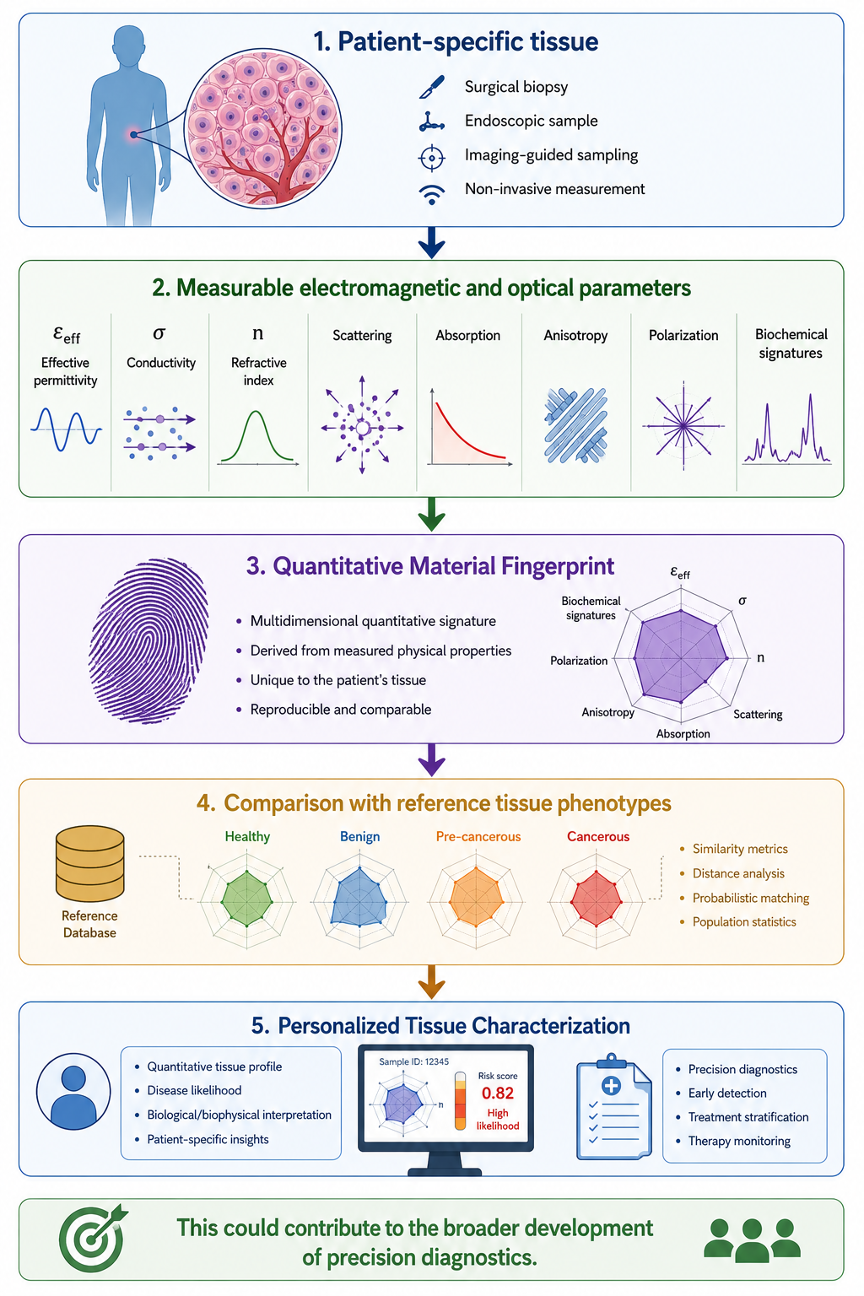
Digital Tissue and the Future of Metamaterial Medicine
An important future direction is the development of digital representations of tissue combining experimental measurements, mathematical models and AI.
A digital tissue model could integrate:
-microscopy;
-spectroscopy;
-electromagnetic properties;
-tissue morphology;
-molecular information;
-effective-medium parameters;
-computational simulations;
-AI-derived biomarkers.
Such models could eventually support virtual tissue characterization, allowing researchers to investigate how changes in microscopic organization influence measurable diagnostic signals.
Why Metamaterial Medicine Matters
The concept could help address several limitations of current biomedical characterization.
Quantification
Moving from predominantly qualitative interpretation toward measurable physical parameters.
Multimodal integration
Providing a common physical framework for interpreting information obtained from different imaging and spectroscopy technologies.
Explainability
Connecting diagnostic features with physical and biological tissue properties.
Reproducibility
Developing standardized descriptors that can potentially be compared across laboratories and imaging platforms.
Personalization
Characterizing the individual physical phenotype of patient tissue.
Translation
Connecting fundamental physics and mathematical modelling with biomedical and potentially clinical problems.
A Long-Term Vision
Metamaterial Medicine represents a transition:
From seeing tissue
→ to measuring tissue
→ to modelling tissue
→ to understanding tissue as a complex material
→ to identifying quantitative biomarkers
→ to supporting disease recognition
The ultimate ambition is to establish a new interdisciplinary framework in which biological structure, electromagnetic properties, mathematical models and artificial intelligence converge to provide quantitative information about tissue state.
Through COST Action TETRA, researchers across Europe and beyond are building the collaborations, experimental methodologies, mathematical foundations and translational pathways needed to investigate this vision.
From Metamaterials to MedicineMetamaterials provide the formalism.
Biological tissues provide the complexity.
Imaging provides the data.
Mathematical modelling provides the physical interpretation.
Artificial intelligence provides the analytical power.
Metamaterial Medicine brings them together.