
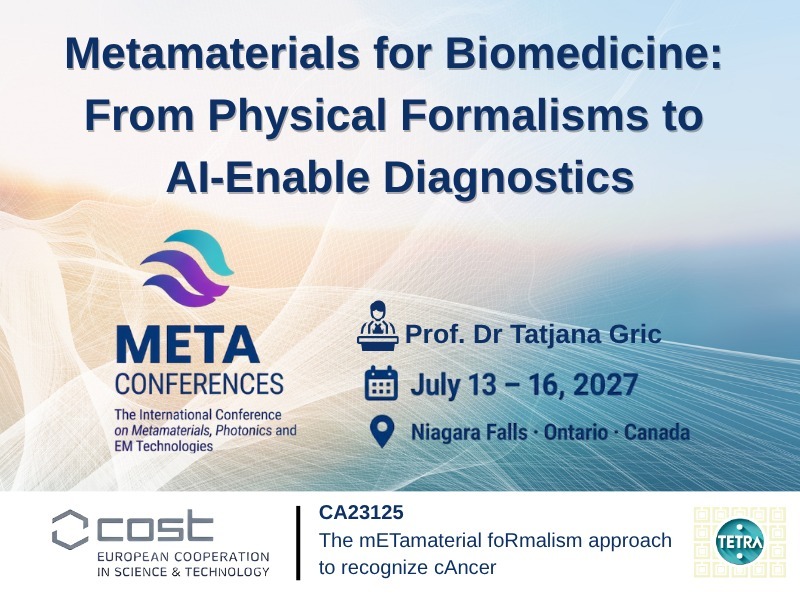
TETRA (The mETamaterial foRmalism approach to recognize cAncer) is pleased to announce the upcoming International Conference on Metamaterials, Photonics and EM Technologies (META). The highly anticipated event is scheduled to take place from July 13 to July 16, 2027, in Niagara Falls, Ontario, Canada. TETRA action chair Prof. Tatjana Gric from Vilnius Tech will conduct the SP11 Special Session titled “Metamaterials for Biomedicine: From Automated Formulations to AI-Assisted Diagnostics” as part of the conference. The dedicated session aims to bridge the gap between theoretical physics, advanced imaging, and clinical healthcare. It will bring together global experts to discuss how the language of metamaterials can revolutionize the way complex biological tissues are characterized and how diseases, particularly cancer, are diagnosed. According to the official agenda, the session will cover a wide array of cutting-edge topics below: Metamaterials and metasurfaces for biomedical applications; Metamaterial-inspired approaches to biological tissue characterization; Electromagnetic and optical biomarkers of cancer and other diseases; Metasurface- and metamaterial-enhanced biosensing; Photonic and electromagnetic imaging of biological tissues; Effective-medium and metamaterial formalisms for complex biological systems; Multiscale electromagnetic modelling of biological tissues; Physics-informed AI and machine learning for biomedical diagnostics; AI-assisted interpretation of optical and electromagnetic measurements; Integration of photonics, metamaterials, and multimodal biomedical data; Experimental and biological validation of metamaterial-based approaches; Translation of metamaterial technologies toward clinical applications. TETRA initiative’s presence at the 2027 META Conference highlights a growing interdisciplinary push to merge physics, biology, and artificial intelligence for the future of medical diagnostics. Researchers and industry professionals are expected to gather at the Niagara Falls venue to share these groundbreaking insights and foster future collaborative research.